Summaries flatten the conversation
A clean recap can miss the hesitation, weak discovery, or ambiguous commitment that actually shaped the outcome.
Connect what happened in a call to the seller behavior, opportunity signal, and process change that deserves attention next.
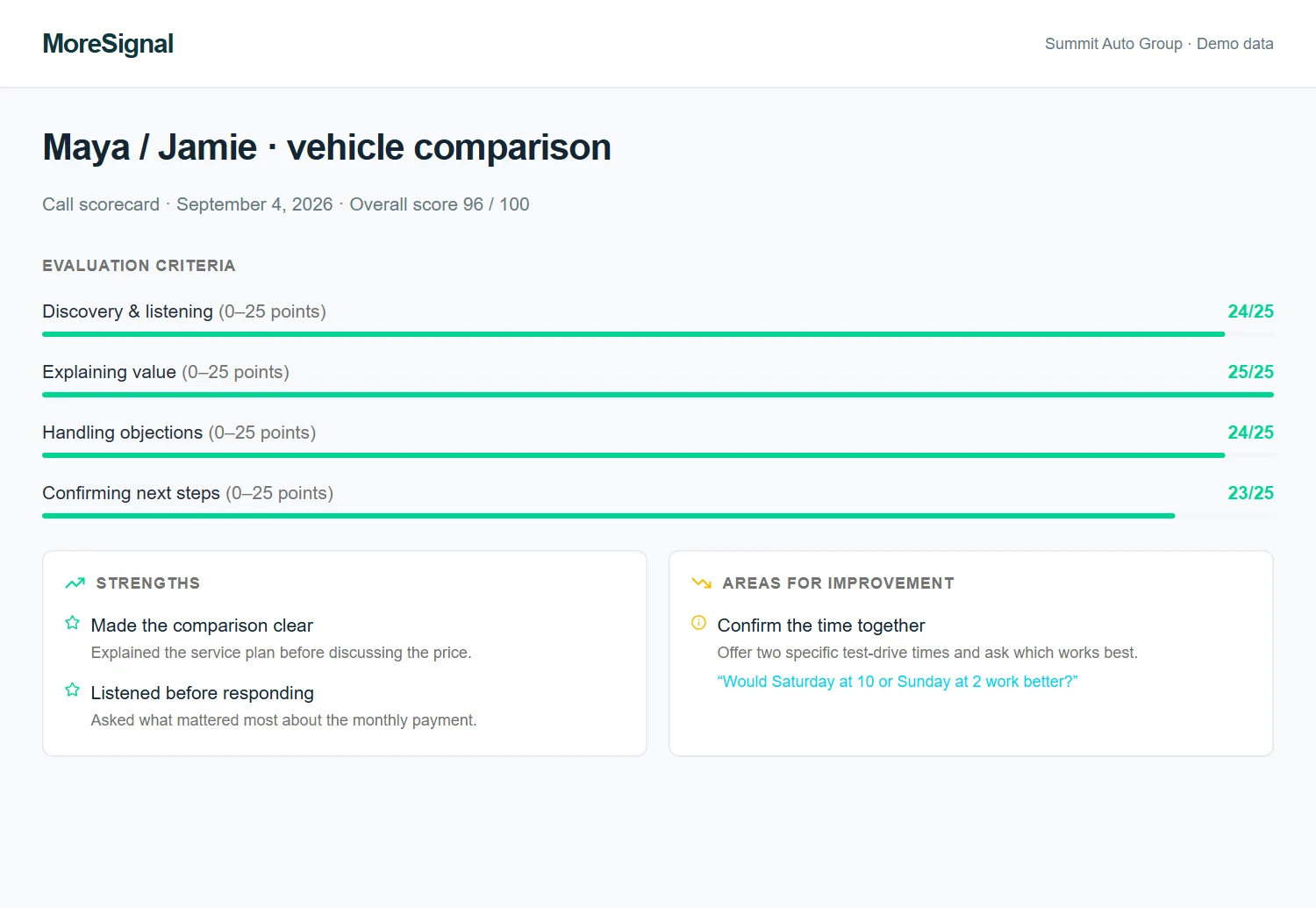
Examples of what a manager might notice and coach. These are illustrative scenarios, not customer results.
Buyer asked who must approve
The seller named the process but did not confirm access to the decision participants.
Add a mutual step that includes the missing stakeholder.
Rep spoke through a pause
The buyer began to explain the operational impact, but the seller moved to a feature response.
Practice one follow-up question before presenting a solution.
Follow-up promised
The call ended without a date, owner, or defined material to send.
Use a three-part close: owner, deliverable, and date.
What needs to improve
Sales teams that want deeper, more actionable analysis than summaries, talk ratios, or isolated keyword counts provide.
A clean recap can miss the hesitation, weak discovery, or ambiguous commitment that actually shaped the outcome.
Talk time and keyword counts show activity but rarely explain whether the behavior helped the buyer make progress.
Every review becomes another full recording instead of a focused inspection of the moments most likely to matter.
How it works
1. Analyze
Detect the conversation outcome, questions, objections, commitments, and signals that deserve review.
2. Evaluate
Apply the team's rubric and evaluate relevant criteria using the surrounding transcript evidence.
3. Improve
Turn the analysis into a focused behavior for the seller and a process insight for the manager.
In the product
Evaluate whether the seller uncovered the problem, impact, urgency, decision process, and mutual next step.
Review what preceded an objection, how the seller responded, and whether the underlying concern was resolved.
Separate full sales conversations from voicemails, callbacks, reschedules, and other outcomes before evaluation.
Find repeated buyer language and seller behavior across calls without manually assembling a sample.
Connected tools
Put the standard to work
Trace each score and coaching recommendation back to the conversation evidence.
Open resourceCopy a weighted rubric for discovery, impact, qualification, and next steps.
Open resourceUse a practical 100-point standard for reviewing real sales conversations.
Open resourceQuestions
No. It narrows the review to relevant evidence and creates a consistent starting point, while the manager supplies business context and judgment.
Yes. Teams can use different rubrics and assignment rules for discovery, inbound appointment calls, demos, service calls, or other workflows.
Depending on the workflow, it can produce an outcome, rubric score, strengths, improvements, key moments, buyer signals, and a focused coaching action.
Bring one real coaching question
Explore the plans, or book a free 20-call review to find a useful coaching priority for your team.