Performance depends on the owner being present
Sales improve when the owner joins the floor or takes over a conversation, then slip when that experience is no longer in the room.
Capture what the owner does differently on successful calls, translate it into observable behaviors, and reinforce those behaviors even when the owner is not on the floor.
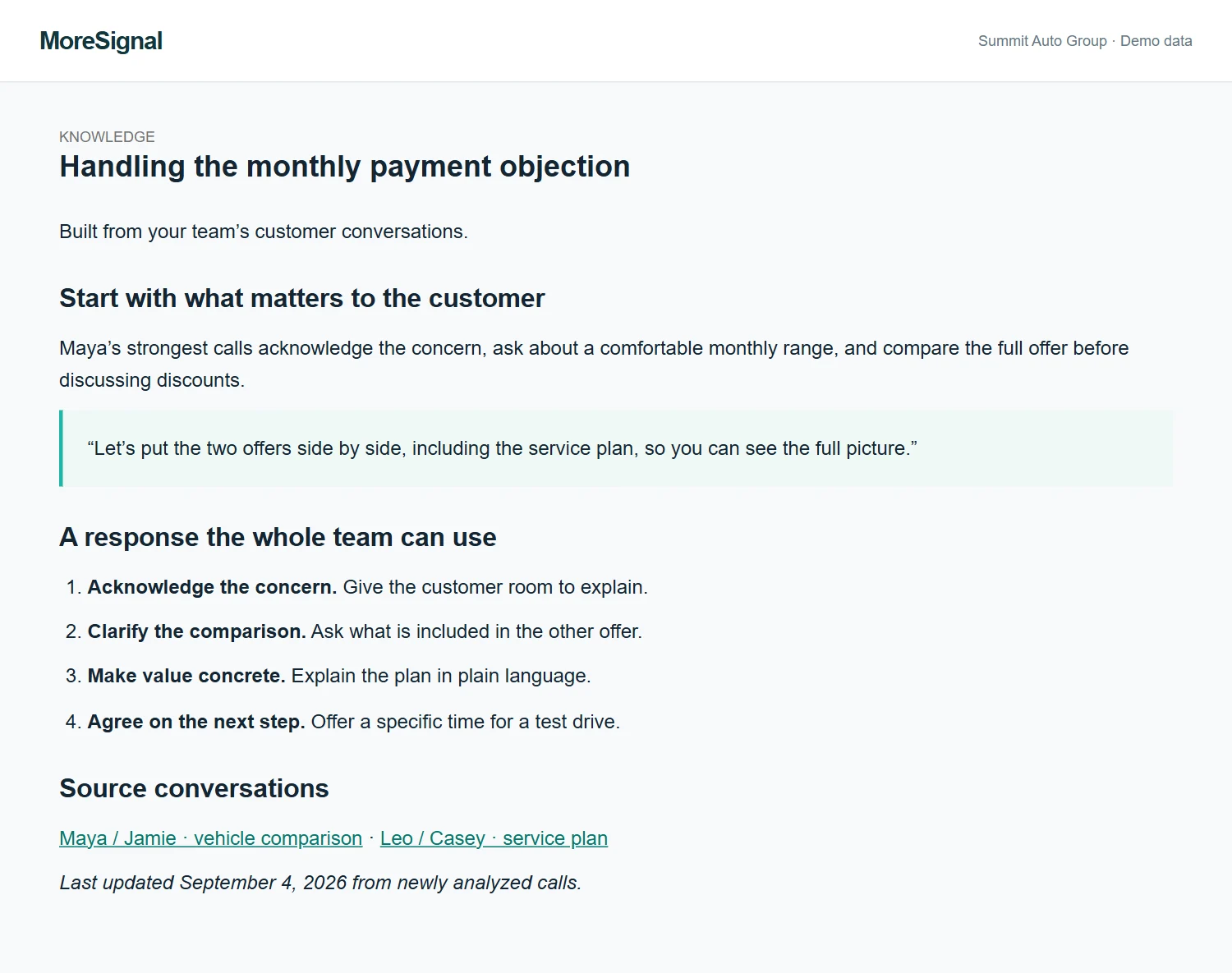
Examples of what a manager might notice and coach. These are illustrative scenarios, not customer results.
The customer raises a price concern
The owner first clarifies budget and decision criteria, while the team tends to answer with a number before understanding the concern.
Add the owner's diagnostic questions to the rubric and practice using them before presenting payment options.
A customer expresses interest but hesitates
The owner confirms a specific next step and time; several team calls end with an open-ended promise to follow up.
Coach employees to secure an owned, dated next step before ending qualified conversations.
One location consistently follows the process
Calls at that location show stronger discovery recaps and clearer appointment confirmation than the rest of the group.
Use those calls as internal examples and focus the other locations on the same observable behaviors.
What needs to improve
Owner-operators, dealership principals, founders, and multi-location sales leaders whose teams perform better when an experienced leader is directly involved.
Sales improve when the owner joins the floor or takes over a conversation, then slip when that experience is no longer in the room.
The owner's discovery questions, explanations, objection responses, and closing instincts are difficult to transfer through occasional shadowing alone.
Managers and employees adapt the process independently, making it difficult to know whether customers receive the same effective experience everywhere.
How it works
1. Capture
Turn the owner's call structure, questions, proof points, objection handling, and next-step discipline into observable rubric criteria and guidance.
2. Compare
Score relevant conversations consistently and keep the transcript evidence beside each criterion so managers can see where execution differs.
3. Scale
Coach the highest-value gaps, recognize strong adoption, and use later calls to see whether the owner's approach is becoming repeatable without constant intervention.
In the product
Model the observable parts of the owner's process for different call types instead of relying on a generic definition of a good sales call.
Compare real conversations with the intended sequence while allowing employees to use natural language rather than recite a rigid script.
Show the exact call moments where an employee followed the approach, skipped a step, or handled a customer concern differently.
Review common strengths and gaps across teams so leaders know where the process is consistent and where local coaching needs attention.
Connected tools
Put the standard to work
Questions
Start with observable moments: the questions the owner asks, how needs are recapped, which proof points are used, how objections are diagnosed, and how the next step is confirmed. Those behaviors become rubric criteria with supporting guidance.
No. The goal is consistent execution of the important behaviors, not identical wording or personality. Employees can communicate naturally while following the proven process.
Yes. Relevant rubric results and conversation evidence can reveal where teams consistently follow the standard and where a location needs focused coaching.
Bring one real coaching question
Explore the plans, or book a free 20-call review to find a useful coaching priority for your team.