Call counts lack meaning
A phone report can show volume and duration without explaining what customers wanted or whether the conversation advanced the opportunity.
Connect call activity to the next stage of the funnel so leaders can see not only how many calls happened, but why customers called and where progress stopped.
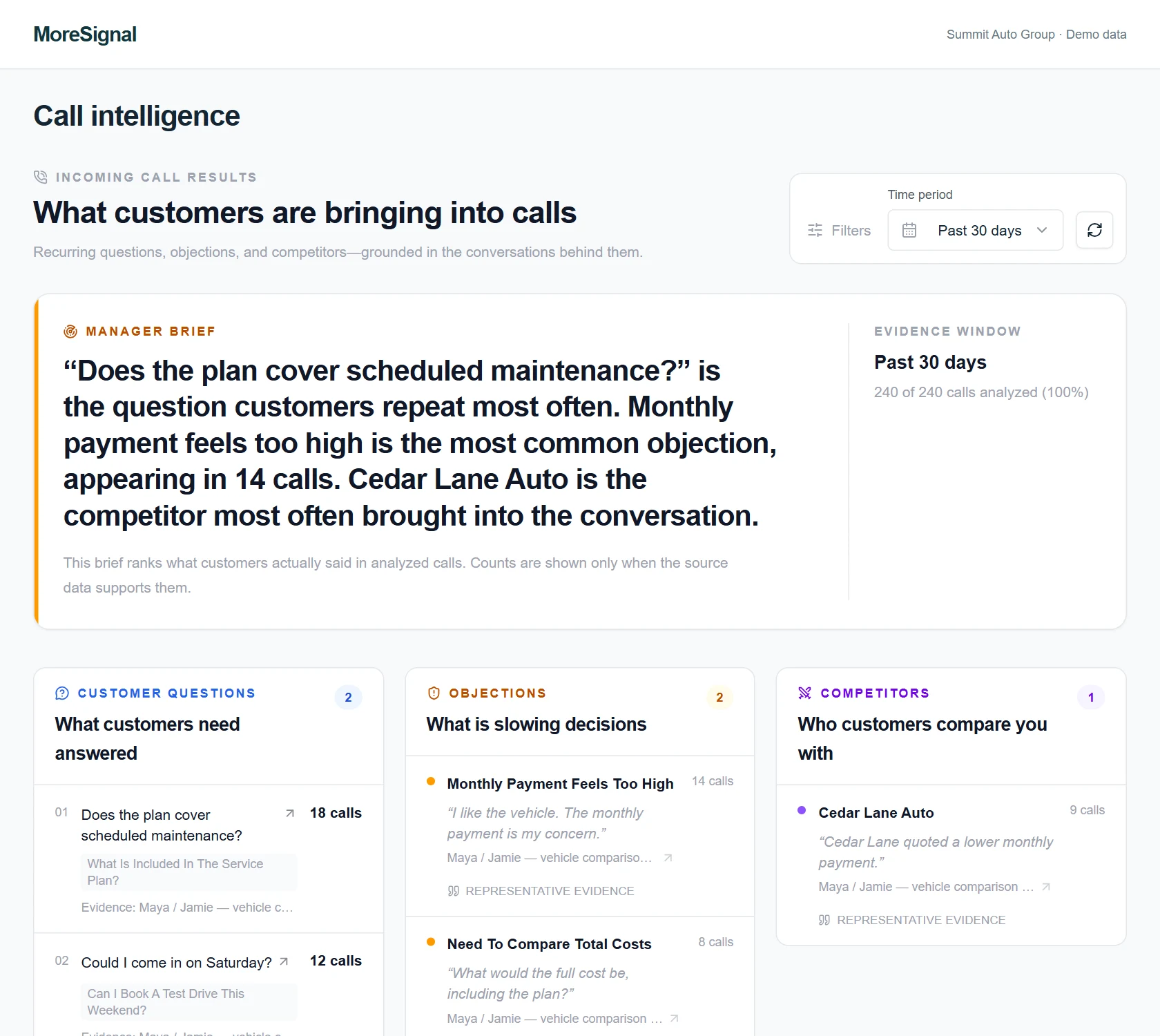
Examples of what a manager might notice and coach. These are illustrative scenarios, not customer results.
Qualified caller did not book
The customer discussed need, timing, and fit but left without a firm appointment or owner for follow-up.
Route the call for follow-up and review the appointment ask.
Campaign produces high-intent calls
Available lead-source data shows qualified conversations, but the booking rate trails the broader call mix.
Inspect the objections and handling on those calls before changing campaign spend.
Callbacks are accumulating
Customers accepted a future contact, but ownership and timing are inconsistent across the reviewed calls.
Require a named owner and dated callback, then monitor completion in the next period.
What needs to improve
Business owners, revenue leaders, sales managers, and operations teams responsible for call demand, appointment conversion, and funnel performance.
A phone report can show volume and duration without explaining what customers wanted or whether the conversation advanced the opportunity.
Fast-moving agents may skip disposition fields, choose the closest option, or leave the CRM record too vague for reliable reporting.
A booking rate shows where the call ended but not the objections, sentiment, questions, or missing next step behind the result.
How it works
1. Classify
Separate qualified conversations from voicemail, transfers, callbacks, and other outcomes, then identify the customer's primary reason for calling.
2. Connect
Track whether the call produced a booking, qualified next step, callback, or missed opportunity while retaining lead-source context when available.
3. Inspect
Move from a rate or trend into the relevant calls to understand the customer language, sentiment, and seller behavior behind the outcome.
In the product
Organize demand around what the customer wanted instead of relying only on the phone number, campaign, or queue that received the call.
Track booked, not booked, callback, and other configured outcomes using the completed conversation as evidence.
Use sentiment as a directional signal beside the transcript, outcome, and call purpose rather than as a stand-alone judgment.
Compare qualified calls and bookings by available lead source to understand which demand reaches the next funnel stage.
Connected tools
Put the standard to work
Questions
Teams can distinguish qualified conversations, bookings, callbacks, not-booked calls, voicemail, transfers, and other configured outcomes relevant to their funnel.
Yes. Outcome reporting stays connected to questions, objections, sentiment, missing next steps, and the supporting conversation evidence.
Available source data can come from the connected phone, campaign, or CRM workflow. Reporting quality depends on that mapping being present and accurate.
Bring one real coaching question
Explore the plans, or book a free 20-call review to find a useful coaching priority for your team.