Managers hear too few calls
Random samples and escalations shape the coaching agenda while repeated behaviors across the rest of an employee's conversations stay hidden.
Turn every completed call into a specific coaching opportunity without asking managers to replay hours of recordings or give feedback from memory.
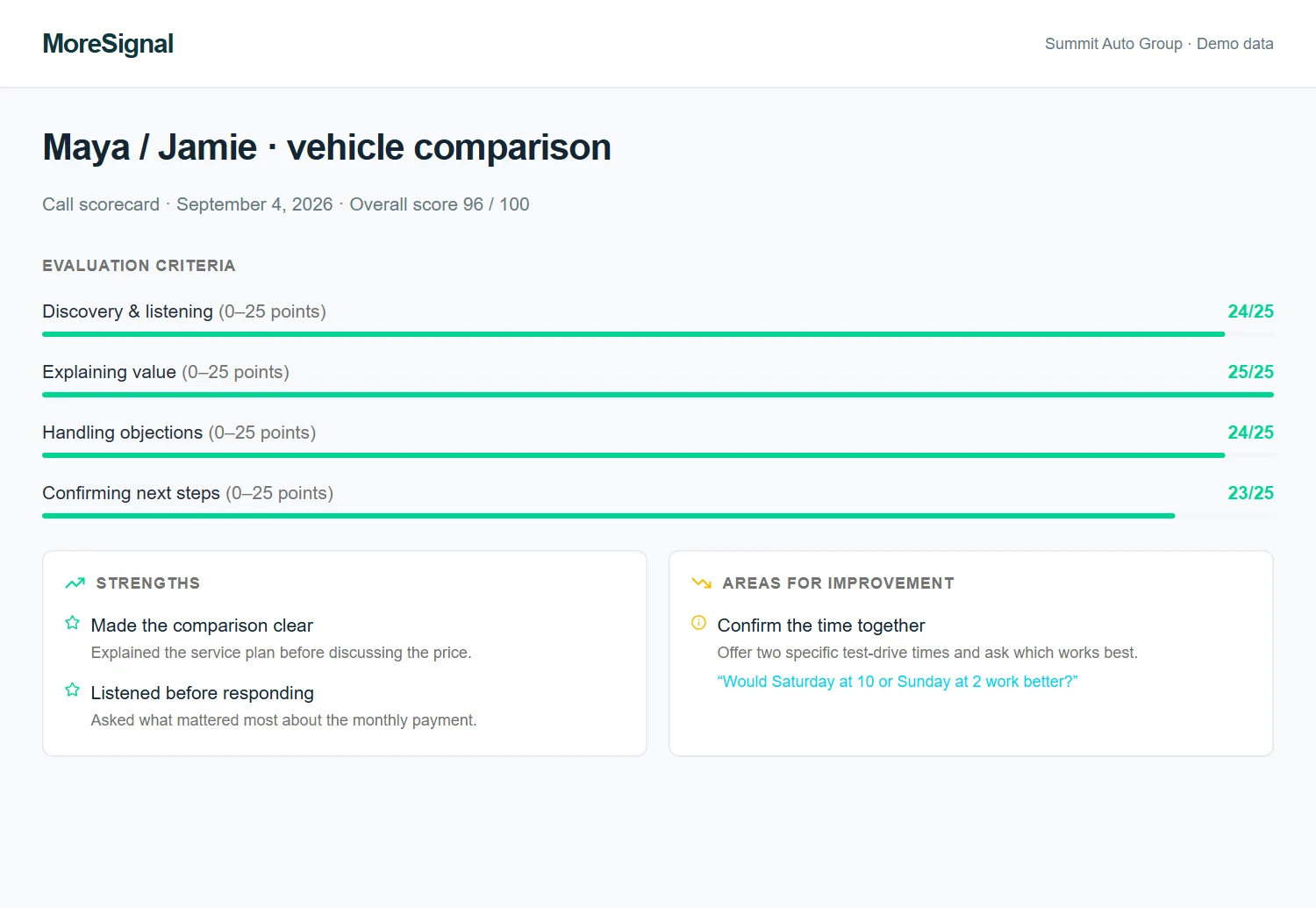
Examples of what a manager might notice and coach. These are illustrative scenarios, not customer results.
The buyer gave a specific deadline
The employee acknowledged the date but did not connect it to a firm follow-up or appointment.
Practice confirming a named owner, date, and next step before ending the call.
A payment concern surfaced
The employee answered immediately without first clarifying the customer's budget or underlying concern.
Use one diagnostic question before choosing the response.
Discovery improved on later calls
The employee consistently recapped the customer's priorities before making a recommendation.
Recognize the improvement and move the coaching focus to the next highest-value behavior.
What needs to improve
Sales managers, contact-center leaders, and customer-facing team leads who need to develop individual employees consistently across more calls.
Random samples and escalations shape the coaching agenda while repeated behaviors across the rest of an employee's conversations stay hidden.
Advice such as build rapport or ask better questions does not show the employee which moment to change or what to try next.
Without a consistent rubric and review history, managers cannot tell whether the coached behavior improved across later calls.
How it works
1. Evaluate
Apply the rubric that matches the call type and outcome, then keep the transcript evidence beside every scored criterion.
2. Focus
Prioritize the highest-value gap instead of overwhelming the employee with a long list of generic recommendations.
3. Reinforce
Use the next conversations to recognize improvement, refine the coaching, and keep the manager and employee aligned.
In the product
Define the observable behaviors, weights, and guidance that represent a strong call for each team and call type.
Show what the employee handled well and where a more specific question, response, or next step would improve the conversation.
Anchor coaching to the relevant transcript moment so the employee can understand the feedback without debating what was said.
Keep comments, areas of focus, and later call results in a repeatable coaching workflow instead of scattered notes.
Connected tools
Put the standard to work
Questions
Yes. Teams can define different rubrics, weights, guidance, and conditional criteria for different call types, roles, and outcomes.
The review keeps supporting transcript moments beside the score and coaching guidance so the employee and manager can inspect the evidence together.
Usually no. A focused coaching priority is easier to practice and measure than a long list of changes delivered at once.
Bring one real coaching question
Explore the plans, or book a free 20-call review to find a useful coaching priority for your team.